An Imperial Kingdom
Italy within the medieval imperial order
The Kingdom of Italy emerged from the Lombard and Carolingian political order and became one of the traditional constituent kingdoms associated with the Holy Roman Empire. Its history joins together Lombard rule, Carolingian kingship, the imperial crown, the great houses of northern Italy, and the developing temporal patrimony of the Church.
Historical scope.
This page concerns the medieval and imperial Regnum Italiae. The Napoleonic Kingdom of Italy and the later Kingdom of Italy governed by the House of Savoy belong to separate historical periods and political traditions.
A concise chronology
From Lombard kingdom to imperial inheritance
The history is long; these four movements provide the essential path.
Sixth–eighth centuriesThe Lombard Kingdom
Following the collapse of imperial rule in the West, the Lombards established a kingdom across much of the Italian peninsula, with its capital at Pavia. Their authority did not encompass the Patrimony of St. Peter or the entirety of southern Italy, where other Roman, Lombard, and later Norman inheritances continued.

774–888The Carolingian Regnum
Charlemagne conquered the Lombard kingdom in 774 and was crowned Emperor of the Romans by the Pope in 800. His son Pepin had already been crowned King of Italy in 781 with the Iron Crown, establishing the recognisable Carolingian Regnum Italiae.
888–962Competing Houses and Kings
After the death of Charles the Fat, the crown passed among several rival claimants. Berengar of Friuli, Hugh of Arles, Lothair II, Berengar II, and Adalbert belong to this period, during which Italian kingship was contested among powerful regional and dynastic houses.
From 962Italy and the Holy Roman Empire
With Otto I, the Italian crown again became joined personally to the imperial dignity. Imperial authority gradually yielded to principalities, communes, city-states, and ecclesiastical territories, yet the Kingdom of Italy remained an important element of the constitutional and ceremonial imagination of the Empire.
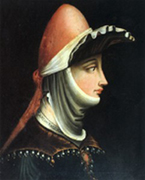
Matilda of Tuscany and the vice-regal inheritance
Countess Matilda, Margravine of Tuscany, was a commanding defender of the Papacy and a central figure in imperial Italy. The Roman-Ruthenian historical account particularly preserves her investiture under Emperor Henry V in 1111 as Imperial Vicar and Vice-Queen of Italy. Her death without issue and the disposition of her lands to the Church link the Tuscan vice-regal tradition with the developing ecclesiastical temporal patrimony.
Land, Church, and Crown
A patrimony formed across Italy
The imperial kingdom was never merely a single capital or court. Its history was shaped by northern cities, ecclesiastical centres, regional houses, and the enduring place of Rome.

The Italian Lands
A network of cities, territories, and regional powers gradually succeeded the more centralized early medieval kingdom.

Republics and Principalities
Imperial Italy became renowned for the political, commercial, and cultural vitality of its republics, communes, and princely states.

The Petrine Patrimony
Historically, the temporal inheritance of Italy developed alongside the ecclesiastical authority and territorial patrimony of the Apostolic See at Rome. Today, the Holy Apostolic See of Rome-Ruthenia preserves that temporal patrimony, together with the Latin Orthodox ecclesiastical authority associated with it, through its ecclesiastical, temporal, and dynastic lines.
The Roman-Ruthenian inheritance
An historical and ecclesiastical patrimony
In Roman-Ruthenian institutional usage, the Pope bears the title Imperial Lord of Italy within the temporal and dynastic patrimony associated with the Apostolic See. This inheritance is understood through ecclesiastical succession to the historical patrimony of Tuscany and through descent from the ancient Margraves of Tuscany and Kings of Italy in the Holy Roman Empire.
The Italian dimension is also expressed ecclesiastically in the metropolitan title of Aquileia, head of the Province of Aquileia and All Italy. The historic office of Imperial Vice-Chancellor of Italy is maintained within the Office of State of the Roman-Ruthenian Curia and is held by the titular King of Etruria.